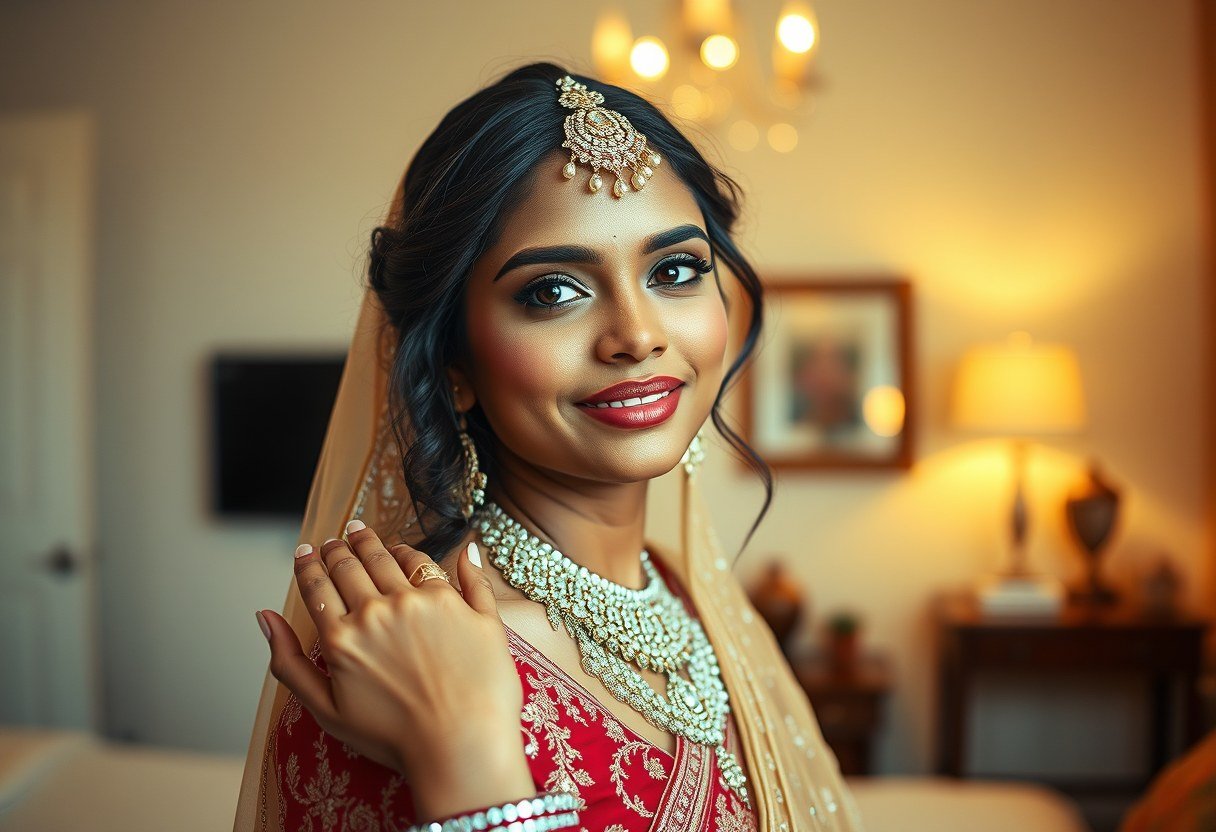
For the first two years of my career I thought the makeup was the hard part. It is not. The hard part is knowing what you don’t know, and I learned that slowly, at other people’s weddings, with other people’s faces.
Early on I did a bride’s base too light because the hall had yellow lighting and I trusted my eyes instead of my instincts. In the photos she looked grey. Nobody said anything to me at the time. Her sister sent me the album two weeks later and I sat with it for an hour. That one mistake taught me more than any course I had taken before it, and it is the reason I now tell students to look at the face, not the mirror, not the phone, not the client’s expression when she first sees it.
So when someone messages me asking about becoming an engagement makeup artist bangalore, I try to answer the way I wish someone had answered me. Honestly. Sometimes the answer is my course. Sometimes it is not.
A girl called me last month, very keen, very nervous. She wanted to start the next batch. I asked her one question: have you done makeup on anyone other than yourself? She said no, not once. I told her to come back in six months after doing ten faces for free. Family, friends, cousins, whoever will sit still for forty minutes.
This sounds like I am turning away business. I am. A batch seat given to someone who has never held a brush on another person is a seat wasted, because she will spend the first three weeks just getting over her own fear. Six months of free faces will teach her more about pressure than my classroom can.
Frazer Town on a Sunday morning is quiet enough that I take my early trial appointments then, and I have had this exact conversation over filter coffee more times than I can count. The ones who come back after six months are almost always the ones who do well.
If you are doing this because your friends say you do nice makeup on yourself, wait. That is not the same skill. Doing your own face in your own bathroom mirror with your own lighting is a completely different job from doing a stranger’s face in a hot parlour with five people watching.
If you cannot commit three months of regular practice, wait. The course is not the hard part. The practice after the course is the hard part, and most people quit there.
If you are doing it only because weddings look like good money, that is a fair reason, but it will not carry you through the boring parts. The trial appointments. The 4am starts. The bride who changes her mind about the lip colour after you have already finished.
A student once asked me if she needed a big Instagram following before taking clients. She was almost embarrassed asking. I told her her first three brides would probably come from her neighbour, and that is exactly what happened. Word of mouth in a building, in a colony, in a family, moves faster than any certificate.
The certificate gets you taken seriously by clients who do not know you yet. That is all. It does not get you booked. It does not get you paid well. It does not get you repeat clients. Those come from how the makeup sits at hour eight, and whether the bride’s mother liked you.
Look, a certificate is a door. What you do after walking through it is the actual career.
Some artists disagree, and that is fair. Online courses work well if you already have hands that know what they are doing and you just want to see how someone else does a particular look, a particular eye, a particular base on a particular skin tone. They work less well if you have never blended foundation on a person who moves and talks and sweats.
The reason is simple. In a classroom I can stop your hand mid-stroke and move it. A video cannot do that. And the mistakes you make on a real face, the ones I catch in the first ten minutes, are exactly the ones you would carry for years if nobody corrects them.
One more thing. A student once brought the wrong shade of foundation for her own skin to class. Half the batch had done the same. That became the first lesson, every batch since. If you cannot match your own skin under classroom light, no video is going to tell you why.
I am biased, I run a studio, so take this with salt. But I have seen enough students come to me after other courses to say it plainly. A big brand name on your certificate matters less than how many people were in your batch.
If there are twenty-five students and one teacher, you will get corrected maybe twice in a whole day. If there are six, you will get corrected the moment your angle is wrong. That difference compounds over three months, and by the end the two groups are not at the same level at all.
Before you pay anyone, ask them the batch size. Ask how many practical hours you will actually get on a real face. Ask what happens if you fall behind. If they dodge the questions, that tells you something.
And while you are at it, if you are building a kit on a budget, Commercial Street still has the best cheap brush sellers in the city if you know which lane to turn into. I have sent many students there and none of them regretted it.
Yes, most of my students start with zero. But you need to be willing to practice on real people, not just yourself. That is the only real requirement. Everything else I can teach.
With my students, the ones who practice seriously are usually taking small paid work within four to six months. The ones who wait for a perfect moment are still waiting a year later. There is no fixed number. It depends on your hands and your nerve.
No. Start small and add as you earn. I have seen students spend their whole savings on branded kits in month one and then have nothing left for the actual practice. Buy what you will use in the next ten faces, not in the next ten years.
You will do the work. I sit with each student, and if your hand is wrong I will move it. This is why I keep batches small. If a studio tells you the batch is forty students and you will get personal attention, ask them how that math works. At Makeup Studio by Suu I have kept it small for exactly this reason, and I intend to keep it that way.
I have trained a lot of students over the years, and honestly the ones who go far are rarely the most talented. They are the ones who show up, ask questions, and take the boring corrections seriously. The rest is time.
When you are searching for an engagement makeup artist bangalore who also teaches, do not just look at their bridal work. Look at how they talk about their students. Look at whether they will answer a hard question directly or deflect it into a sales pitch.
The right course for you might not be mine. That is genuinely fine. What matters is that you go in with clear eyes, ask the awkward questions, and give yourself the six months of practice that most people skip. Most people skip this, but it is the part that decides everything.
If you ever want to just talk it through before deciding anything, message me. I answer between appointments, so give me a little time, but I will answer.
Go do ten faces first. Then we will talk properly, and you will know exactly what you are signing up for.


© 2026 Makeup Studio By Suu All Rights Reserved.
Developed & Marketed By  Seeknext


