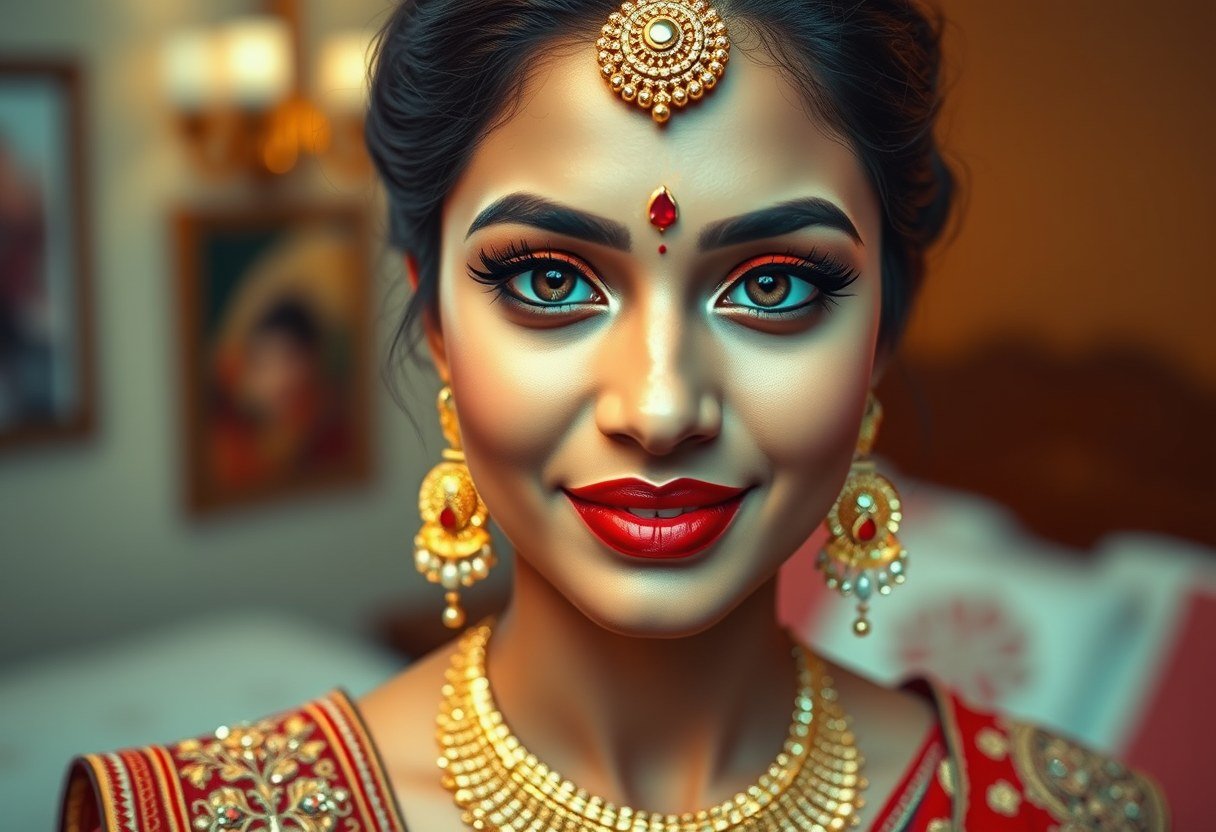
I will say something that gets me side-eye from other artists. The makeup is not the hardest part of a wedding morning. The hardest part is the twenty minutes before you open your kit, when a room full of people is watching you and nobody has said out loud what everyone is thinking, which is that this face has to be right and there is no second take. I have felt this for years and I still feel it every single time. Some artists I know disagree, and that’s fair. They will tell you it is all technique, all product, all light. But technique does not calm a nervous mother. Technique does not know when to stay quiet. The craft includes all of it.
I run a studio and academy in Frazer Town. Brides come to us from Whitefield, from Malleshwaram, from Jayanagar, and these days a lot of them are getting married in Coorg, in Chikmagalur, in Goa, in a resort two hours outside the city. When people search for a destination wedding makeup artist bangalore, what they are really looking for is someone who can hold steady in a place they have never worked before. That is a different skill from doing beautiful makeup in your own chair.
Most of my outstation work happens in rooms that were not designed for makeup. A banquet hall with yellow bulbs. A resort room with one small window facing a wall. A dressing area where the mirror is four feet away and the light comes from behind your own head. You cannot trust any of it. What I trust is my hand and a small handheld light I carry everywhere, and I check the base twice, once in that light and once in daylight if I can get near a door.
The mistake new artists make is matching the foundation to what they see in the room. In a warm yellow room everything looks warmer than it is. Then the bride steps into a lawn at 7am and the base reads grey or ashy. I have corrected this on the spot more times than I want to remember. It is the single most common thing I fix when a bride calls me after a trial done elsewhere.
Bangalore weather is kind to makeup for most of the year. That is a genuine advantage we have here. But October, after the rains, the humidity sits on the skin in a way that catches new artists off guard. Base starts to move by hour three. Blush fades into nothing. I change my prep and my setting routine completely for those weeks, and I tell my students to do the same. It is not about a better product. It is about reading the day before you start.
A trial is not a preview. It is a conversation with the face. You learn how the skin behaves, how the bride talks about herself, what she means when she says “natural” versus what she actually wants, and whether she has ever worn a full base for more than two hours in her life. You also learn whether she will sit still or check her phone every ninety seconds. That last one matters more than people think.
For destination weddings the trial is even more important, because the wedding day is a compressed version of everything. There is no time to experiment at the venue. The trial is where the experimenting happens. I will not take a destination booking without a trial, and I say that plainly upfront. Some brides are far away and it is inconvenient. I understand. We do it on a video call with a kit list, or she comes in once when she is in town for shopping. But we do it.
Party makeup is a sprint. You have a look in your head, you execute it, the client leaves, and if something shifts by hour four nobody is looking at old photos of it forever. Bridal is a marathon with a camera at every turn. The same face is being photographed from 6am to 11pm, in daylight, in flash, in candlelight, in a video that will be watched by relatives for years. Everything has to hold.
Most Bangalore weddings have a 6am to 9am muhurtham window. That means being awake at 3am and working by 4am at the latest. The bride has been up since 2am for her oil bath and her hair. She is tired. Her mother is tired. The house is loud. Your job is to be the calmest person in the room.
| What changes | Party booking | Destination bridal |
|---|---|---|
| Start time | Usually evening | 3am to 4am |
| Number of looks | One | Two or three in a day |
| Lighting | Known venue | Whatever the room gives you |
| Margin for error | Some | Almost none |
I had one bride in Whitefield who changed her lip colour four times on the morning of the wedding. Four. She had a reason every time. The saree looked different in the room light. Her mother said something. Her cousin said something else. I kept wiping and reapplying and saying nothing, because arguing with a bride at 5am is not a strategy. We went with the third one. She was right.
Honestly, the instinct is almost always correct. The bride has been looking at her own face for years. When she says something feels off, it usually is. My job is not to defend my first choice. My job is to make the choice that works, and if that means going back to option three after an hour of options one, two and four, then that is what we do. This is where trust lives. Not in the first stroke, in the tenth.
Look, this is why I tell my students that bridal work is ninety percent reading people and ten percent actual product. The product matters. Do not get me wrong. But a bride who trusts you will sit still, will tell you what she is really thinking, and will let you fix things before they become a problem.
We were doing a muhurtham at 4am in Malleshwaram and the power cut out mid-base. Total blackout. The generator took a while. I finished the eyes by phone torch held in my teeth for part of it, which is not a technique I would teach, but you do what the morning asks. The photos were fine. The bride laughed about it later. I did not laugh until I got home.
That is the reality of this work in Bangalore. You plan for everything and then the power goes. What keeps a look going through a morning muhurtham and an evening reception is not one magic product. It is layering done correctly, a setting routine matched to the season, and a touch-up kit the bride can actually use herself or hand to a sister. I build that kit with her at the trial. Most people skip this, but the touch-up kit is half the job.
Some artists disagree with how much I lean on setting and layering versus just using a heavier base. That is a real debate and there are arguments on both sides. For humid October weddings I will always choose layers. A heavy base in that weather cracks and looks like a mask by hour four.
For destination work, honestly, yes, most of the time. Many venues do not have a reliable hair person or the bride wants one artist for the whole morning. You can build a career on makeup alone in the city, but for outstation weddings the artist who can handle both gets called more often. Learning basic bridal hair changed how I work.
For peak season dates, four to six months is comfortable. For a good outstation artist in November or December, earlier. There is a limit to how many weddings anyone can physically take in a month, and destination work means travel days on either side. If you are reading this in the middle of wedding season, start now.
It depends on the bride. If you have sensitive skin, if you have had bad experiences, if you want a specific look that local options cannot do, then yes. If you are easy-going and the local artist comes highly recommended by someone you trust, save the travel cost and spend it on the venue. There is no single right answer here.
I am biased, I run a studio and I teach this work, so weigh that when you read the above. What I can tell you is that the brides who come to us for destination weddings usually come because someone they know sat in our chair first. That referral chain is how this work grows. It is slow and it is honest.
If you are planning a wedding, or you are an artist thinking about moving into bridal work, and you have a question about any of this, send it across. You can reach us through our contact page or find more about how the studio runs at Makeup Studio by Suu. WhatsApp works too, and it is usually the fastest way to get me between appointments. The number is on the contact page.
People think a destination wedding makeup artist bangalore is a job about brushes and palettes. It is really about showing up at 3am, in a strange room, and being the one steady thing in a morning that is moving very fast. I have not found a shortcut for that in all these years.
Suu
I run Makeup Studio by Suu in Frazer Town, Bangalore, where I have been working with brides for 17 years and training artists through our academy. Most of what I know, I learned sitting across from a nervous bride at 4am.


© 2026 Makeup Studio By Suu All Rights Reserved.
Developed & Marketed By  Seeknext


