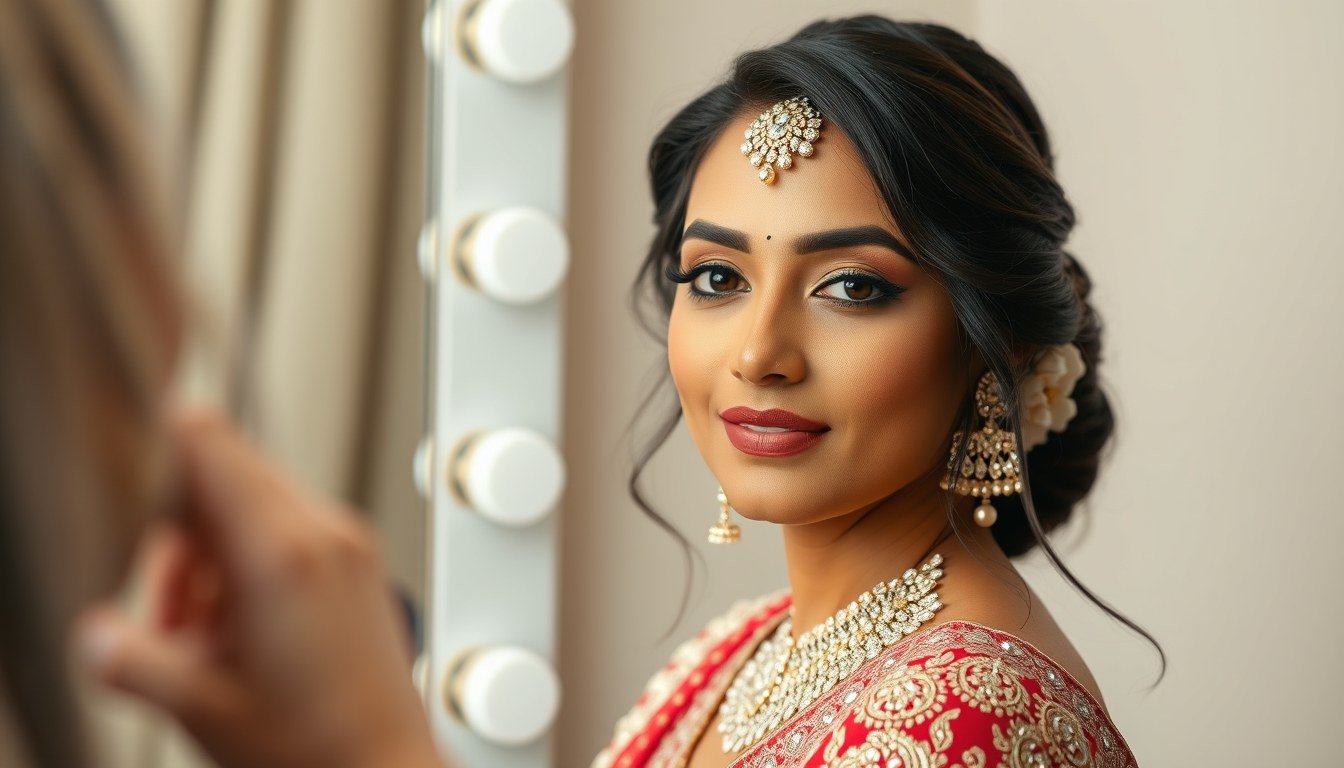
I don’t think you should do free makeup for “exposure.” Most artists will tell you the opposite, that a few free brides build your portfolio, and I understand the logic. But I’ve watched too many people give away a year of weekends and end up with a phone full of pretty pictures and no rent money. Your kit costs money before a single face walks in the door.
So let’s talk honestly about the working side of this. Not the highlight reels. The pricing, the quiet months, the slow first year, the parts I wish someone had sat me down and explained when I was starting out in Frazer Town with one train case and a lot of nerve.
Here’s a mistake I see constantly. A new artist finishes her course, does two lovely brides for friends, and then jumps straight to charging what the established names charge. Or the reverse, she undercharges for years because she’s scared nobody will book her.
Both are guesses. Neither is a price.
When I sit with students on the money question, I ask them to add up the real cost of one bridal booking first. Products used, travel across the city, the assistant if you bring one, the hours. Not the retail price of a lipstick, the actual amount that leaves the tube. Most people skip this, but it changes the whole conversation. Once you know a booking costs you X, you know what number you cannot go below without paying the bride for the privilege of working on her.
In my experience, the first ten brides should sit in a modest band you can defend out loud. Low enough that you’re genuinely learning on the job, because you are, and honest enough that it respects your kit and your time. I’m biased, I run a studio, but I’d rather see an artist charge a fair small number than a “please book me” number. Cheap pricing attracts the client who will haggle you at every step, and it’s very hard to climb out of that hole later.
Raise your price after every few bookings, not after a year. Small steps. Your regulars won’t blink, and new brides only ever see the current number.
Nobody warns you that the first year is mostly admin. You’ll spend more hours replying to messages and building a kit list than you will with a brush in your hand. That’s normal. It feels wrong because the feed you learned from only shows the finished face.
I remember a student from a recent batch who was terrified of winged liner. Genuinely scared of it. First two weeks she’d stop halfway and want to wipe it off. By week six she was doing wings on brides without a stencil, without a second look. That’s not talent appearing out of nowhere. That’s just reps. The first year is reps.
The other thing about year one is that your calendar will look empty in places and you’ll panic. Don’t. Some of those empty weekends are you building the thing that fills the busy ones. Booking systems, a clean kit, a website that doesn’t look thrown together. If you want to see what a settled version of this looks like, the work we do at the studio is a fair picture of the pace after the scramble years.
A word on the technique side, because it matters for your money. Reception makeup in Bangalore runs heavier than the morning look because of hall lighting. Brides rarely believe me until they see the photos. If you underdo a reception face, the camera and the yellow hall lights will flatten it. Getting that balance right is a skill that lets you charge more. You can see the difference it makes in the kind of bookings we take on.
Wedding season here peaks November to February, and again around May. If you look at your diary and see a wall of red in those months and then a lot of white, that’s not a mistake on your part. It’s the shape of the work.
Artists who plan for the gap in March and April survive. Artists who spend the peak months like the money will never stop, don’t. I’ve watched both. The ones who last treat the busy season like a harvest and the quiet months like a season of their own, for practice, for teaching, for the unglamorous parts of the business.
The honest limitation of a makeup course is this. It can teach you to do a face well. It cannot hand you a full calendar in year one. The technique you can learn from us. The patience and the money sense, you build yourself, and some months are leaner than the brochure suggests.
| Stage | What you’re really doing | Money reality |
|---|---|---|
| First 10 brides | Learning on real faces, building a portfolio | Modest prices, cost your kit first |
| Year one | Reps, admin, empty weekends that feel scary | Irregular, rising slowly |
| Peak season | Back-to-back bookings, long days | Strong, but save some |
| Mar-Apr gap | Practice, teaching, systems | Plan ahead, live off the peak |
Look, the reason I talk about the money at all is that I’ve seen skilled artists give up not because they couldn’t do the work, but because nobody told them the first year looks like this. The work itself, the bridal, the reception lighting, the technique, that part is teachable. This is my honest guide to a professional makeup artist for events bangalore, money and all, and I’d rather you knew it now than three years in.
One more thing I tell my students every batch. A student once brought the wrong shade of foundation for her own skin to class. Half the batch had done the same. That became our first lesson, and it’s the same one I’ll give you here. Know the tools, know the cost, know the season. The rest is reps.
Some artists disagree with all of this, and that’s fair. There’s more than one way to run a makeup business in this city. This is just the one I’ve seen hold up over the years.
If you’re thinking about this work, start by counting your kit honestly before you count your followers. That number will tell you more than any feed.
Suu
I run Makeup Studio by Suu in Frazer Town, Bangalore, and I’ve been doing this work for 17 years. I teach the technique and, lately, the money side too.


© 2026 Makeup Studio By Suu All Rights Reserved.
Developed & Marketed By  Seeknext


