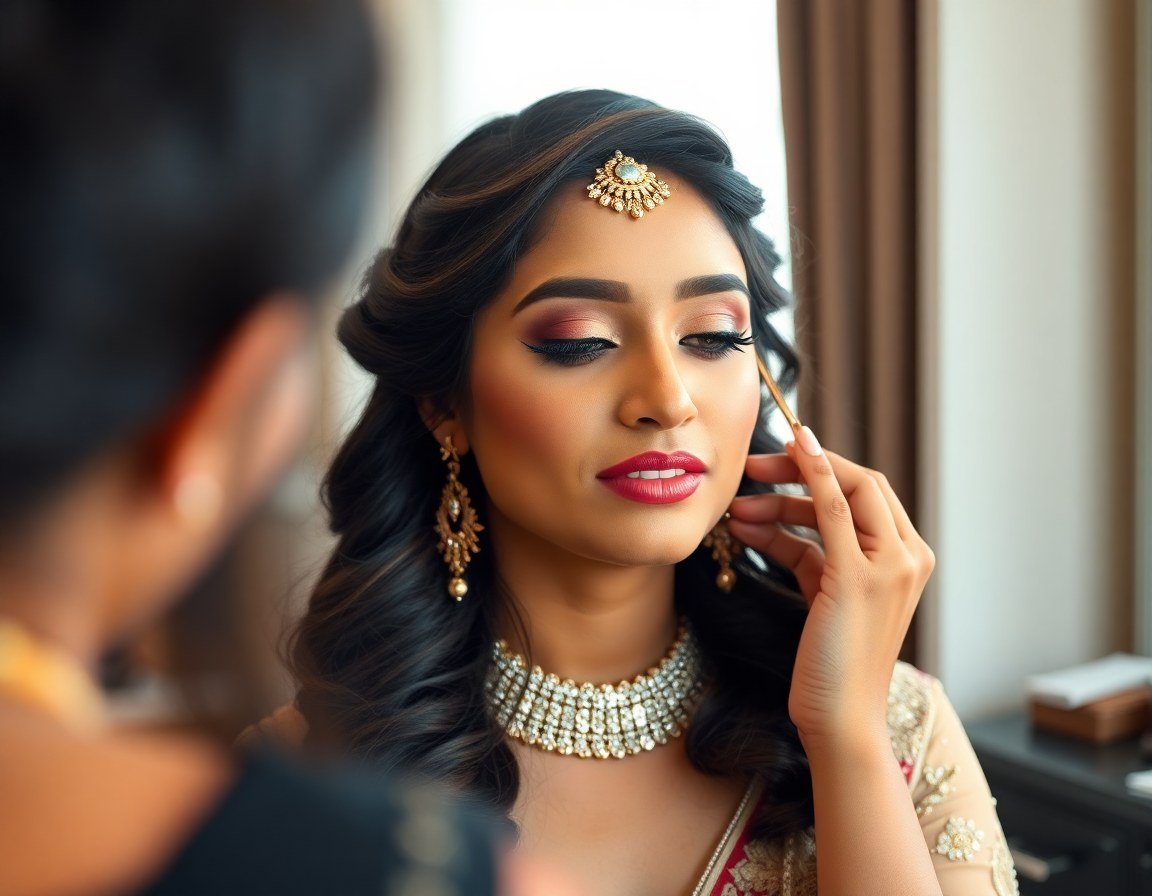
Last Sunday I was doing a trial at the studio before the bride’s family arrived. Frazer Town on a Sunday morning is quiet enough that I take my early trial appointments then. The only sound was the ceiling fan and the click of my brush case opening. She was a South Indian bride, and we were going back and forth on whether to deepen the bronze in her crease or keep it soft. She asked me, mid conversation, “Suu ma’am, but how much do you actually make in the first year?”
I get this question almost weekly. Usually from students at the makeup academy kammanahalli area parents send their daughters to, but also from women who have been working in IT for six years and feel a pull towards this. They all want the same thing. A straight answer about money and time and struggle. No fluff.
So here it is, honestly, from my side of the table after 17 years in this work.
The short answer
Your first year in bridal makeup in Bangalore will probably earn you less than a junior software tester, but more than a call center job, if you treat it like a business from day one. The ones who fail are the ones who treat it like a hobby with lipstick.
Most people assume the first year is about learning technique. It is not. The technique is the easy part. If you have basic hand steadiness and an eye for symmetry, any decent course teaches you bridal work in three months. The first year is actually about learning to handle uncertainty.
A student once brought the wrong shade of foundation for her own skin to class. Half the batch had done the same. That became the first lesson, not about color matching, but about how we all see what we expect to see instead of what is actually there. You will do this with clients too. You will think the bride wants a dewy look because her sister said so, but the bride herself has been staring at matte skin on Pinterest for a year.
In the first year you are booking maybe two to four bridal gigs a month, plus some engagement functions and reception makeup. With my students, the ones who start pricing at eight hundred to fifteen hundred rupees per bridal look in their first few months usually get work, because they are building a portfolio. The ones who start at five thousand sit idle. It is a hard truth.
That means a realistic first year income from bridal work alone is somewhere between one and three lakhs, depending on how aggressively you network with photographers and how many free brides you did during your training period. I am not quoting industry data. I am telling you what I watch happen in my own batches every year.
Here is where most beginners get emotional. They price based on how hard they worked. Nobody cares how hard you worked. They care about the result and the reliability.
I tell my students to price their first ten brides at a rate that covers their product cost and travel, plus a small profit. That usually lands between eight hundred and two thousand rupees in Bangalore right now, depending on the area. Not because you are worth less, but because you are buying testimonials. Each of those first ten brides becomes a source of photos, referrals, and confidence.
A student last batch spent her first two weeks terrified of winged liner. By week six she was doing it on brides without a stencil. She charged one thousand rupees for her first three brides, then fifteen hundred for the next five, and by her tenth bride she quoted three thousand and got it. The jump was not because her skill changed that much. Her confidence changed, and clients smell confidence.
Most people skip this, but you should also write down your pricing logic. If you do not know why you charge what you charge, you will crumble when a client says “but my cousin’s friend charges only seven hundred.” You need a sentence ready. Mine is simple. “Then your cousin’s friend can do your makeup.”
May to July in Bangalore is wedding season. October to December is peak. But February and September are dead. Nobody tells you about the dead months.
In your first year, you will have a month where you do zero bridal bookings. Zero. And your product kit still needs restocking, and your phone bill still comes, and your mother will ask if you are sure about this career. That month is where most people quit.
I have a rule for my students. Keep a separate bank account for your kit and marketing. Put twenty percent of every booking into it. When the dead month hits, you do not panic, you dip into that account and you treat the quiet weeks as practice time. Re-do your own eye looks. Test new products. Reorganize your kit. I do this myself even now.
One honest limitation of this career is that it is seasonal and weekend heavy. You will work Saturdays and Sundays while your friends have brunches. You will miss family functions during peak wedding season. Some artists disagree, and that is fair, but I have never seen a successful bridal MUA in this city who had a normal weekend schedule for the first five years.
I get at least one message every month from a working professional who wants to quit her job and enroll in a makeup academy kammanahalli or Frazer Town or Indiranagar, take the full time course, and start freelancing immediately. My answer is almost always the same. Do not quit yet.
Look, the course itself takes three to four months if you are doing it seriously. During that time you have no income from makeup. If you have savings for six months of expenses, fine. If not, keep your day job and do weekend classes or evening batches. I have had students who worked full time at tech companies and trained with me for six months on weekends. They started freelancing before they quit their jobs, because they were booking brides while still getting a salary.
The right time to quit is when your makeup income covers your monthly expenses for three consecutive months. Not before. That is the rule. If you are earning fifteen thousand from bridal work and your expenses are forty thousand, you are not ready. You are just tired of your job, and that is a different problem.
I know this is not the romantic answer. But the romantic answer leads to credit card debt.
I would tell her to stop buying every new palette that launches. The product does not make the work. Your eye does. I would tell her to charge for trials from the start, even if it is just five hundred rupees, because free trials attract clients who do not value your time.
I would tell her that South Indian bridal work in Bangalore leans towards defined brows and warm tones. North Indian brides here usually ask for something cooler. Learn both, not one. The artists who only do one style cap their own market.
And I would tell her to build relationships with saree drapers and hairstylists. They get asked for recommendations constantly. One good hairstylist has sent me more brides than any Instagram ad ever did.
The location does not matter as much as the teacher and the batch size. What matters is how many live bridal sessions you get to assist in, not how many theory classes you sit through. Ask the academy directly how many real brides each student works on before certification. If the number is below five, keep looking.
With my students, I recommend a starter kit budget of twenty five to forty thousand rupees. Not eighty thousand. You do not need five shades of every blush. You need good foundations, concealers, a solid eye palette in warm neutrals, and professional brushes. You will add products as you earn.
If you expect the academy to hand you clients, no. If you expect to build your own network through trials, photos, and referrals from your classmates, yes. About half of my students start earning within three months of finishing. The other half took longer because they were shy about posting their work or asking brides for testimonials. It is a sales job as much as an art job.
I have trained a woman who started at 42 after her kids went to college. She is now a full time bridal MUA with a six month waiting list. Age matters only if you let it stop you from practicing on real faces every week. Your hands do not age as fast as your excuses.
If you are seriously considering this work, come see the studio and talk to me in person. Frazer Town is easy to reach from most parts of Bangalore, and the contact page at the contact page has my number. I do not bite. I do, however, check your nails when you walk in. Clean nails matter in this work.
The bride last Sunday ended up choosing the deeper bronze. She looked beautiful, and her mother cried a little, and I packed my kit by 11 AM while the street outside was still quiet. That is the thing about this career. The money comes in waves, the hours are odd, and sometimes you sit alone in a quiet studio wondering if you should have studied engineering instead. But then a bride sends you a photo from her wedding night, or a student from the makeup academy kammanahalli area sends you a message saying she booked her first solo bride, and you remember why you stayed.
The reason I am still here after 17 years is not the money. It is the moment when a nervous daughter looks in the mirror and finally sees herself, not a stranger. That moment never gets old. Neither does the quiet of a Sunday morning with only one bride to make beautiful.


© 2026 Makeup Studio By Suu All Rights Reserved.
Developed & Marketed By  Seeknext


