Updated September 19, 2026
Most artists I meet want to talk about products. Which foundation, which palette, which setting spray holds up through a Bangalore summer. I think blending matters more than any of that, and plenty of people in this industry will tell you that is an old-fashioned opinion. Fine. Let them. I have watched a face look flat and plastic with expensive products and I have watched a face look like skin with a sponge that cost ninety rupees. The difference is almost always in the hands, not the bag.
So when students ask me about makeup artist course fees bangalore 2026, before we even get to the number, I ask them what they think they are paying for. If the answer is products, they are going to be disappointed. If the answer is repetition, hours of doing the same movement until their wrist knows it, then we can talk.
The short version
Fees in Bangalore for a serious course sit in a range depending on how many hands-on hours you get. What matters more is how many faces you touch in class. Ask that question first, always.
I see this in every new batch. Someone takes a brush, sweeps colour across the eyelid, and calls it blending. That is smudging. Blending is control. You are deciding exactly where one colour ends and the next begins, and the transition between them should look like it happened on its own, without a visible line anywhere.
In class I make students do this on their own forearm first, not on a face. Same skin, same texture, and no eyelashes getting in the way while they learn the pressure. Light pressure, small circles, and patience. A student once told me her arm was sore by the end of the first week. It was. That is the work.
Here is the part most people skip, and it is the part that separates a photo that looks professional from one that looks like a tutorial. You blend the edges of the eyeshadow, yes, but you also blend where the base meets the neck, where the blush melts into the cheek, where the contour softens into the jaw. Every visible edge is a decision you did not finish.
A few years ago I was doing a muhurtham in Malleshwaram that started at 4am. Midway through the base, the power went out. No backup light in that room, generator was running late, and the bride was calm while I was not. I finished her eyes by phone torch. Held the phone in my teeth for part of it. The photos came back and they were fine, because the base was already blended properly before the lights died. If I had rushed that base, the torch would not have saved anything.
That morning taught me something I now say in every batch. Your technique has to work when conditions are bad, because conditions will be bad at least once a month.
Students come in thinking shade matching is about finding the closest bottle. It is not. Indian skin has so much variation within a single face, and the neck is almost always warmer or darker than the cheek. You are not matching one shade. You are matching a range and then blending the difference until the eye cannot find where it changes.
I’m biased, I run a studio, but I think this is the single hardest thing to teach and the single most valuable thing to learn. You can pick up contouring from a video. You cannot pick up shade matching from a video, because the video does not show you this bride, in this light, at this hour.
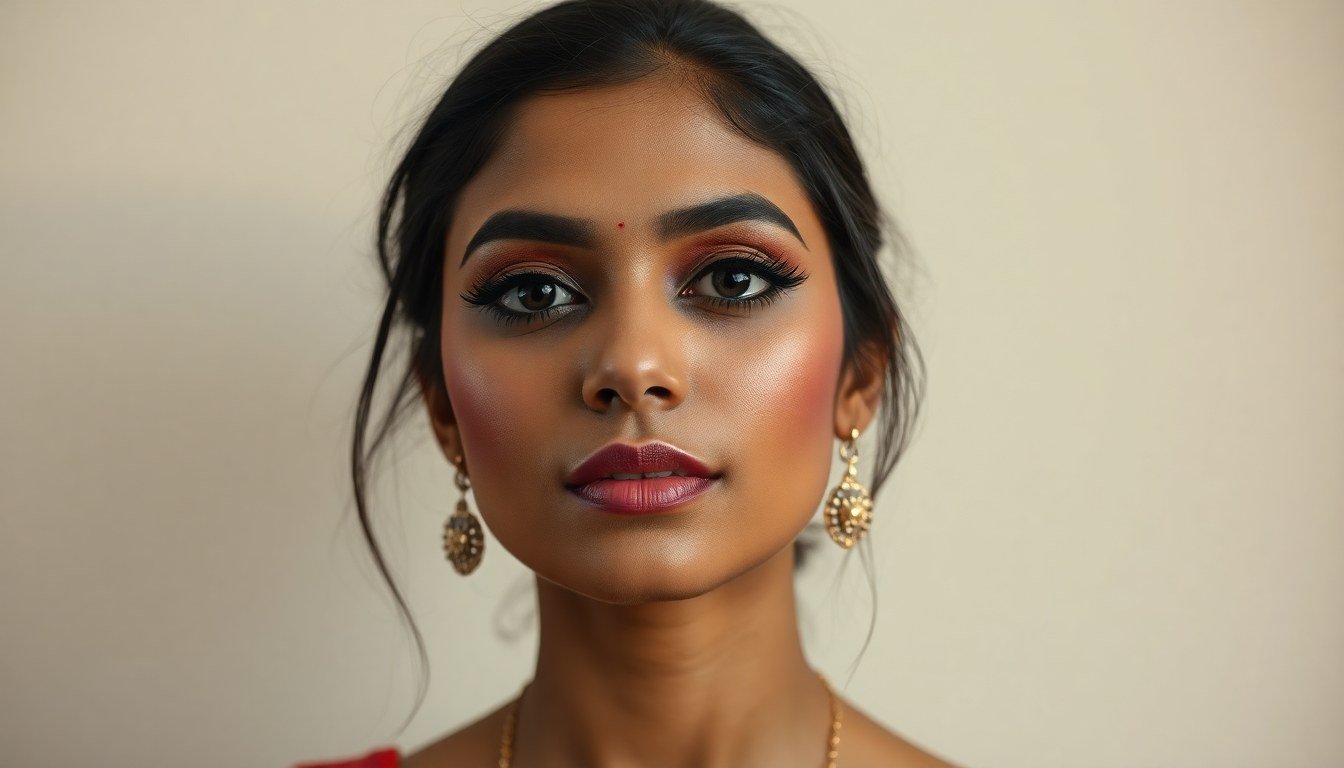
South Indian bridal work in Bangalore leans towards defined brows and warm tones. Golds, coppers, deep rusts, something that catches the kanjeevaram without fighting it. When I get North Indian brides here, they usually ask for something cooler, more mauve and rose, and I adjust. Same city, two different briefs. You learn to read which one you are getting in the first two minutes of a trial.
I used to push heavy full-coverage foundations for everyone. I don’t anymore. On most Indian skin, under most Bangalore humidity, a heavy base starts breaking down by hour four and then you are patching instead of enjoying the wedding. I moved to buildable coverage, thin layers, and a setting routine that respects how much the face will sweat during the ceremony.
I also stopped recommending heavy loose powders under the eyes for mature brides. It settles into the fine lines and makes everyone look older in the photographs, which is the opposite of what we are there to do. Some artists still swear by it, and that’s fair. Every hand has its own logic.
| What I used to do | What I do now | Why |
|---|---|---|
| Full-coverage base, one layer | Buildable coverage, thin layers | Holds up through humidity |
| Heavy loose powder under eyes | Light powder, small areas only | Does not settle in fine lines |
| Cool-toned blush for everyone | Warm blush for South Indian brides | Sits better on warm undertones |
| Same base for muhurtham and reception | Lighter morning, heavier evening | Hall lighting is brutal on soft base |
Reception makeup in Bangalore runs heavier than the morning look because of hall lighting. Brides rarely believe me until they see photos. That soft, pretty base you loved in daylight at 8am turns flat and washed out under halogen at 8pm. So I build a slightly stronger base for the evening, and I build the eyes to hold against direct light rather than diffused light. Same bride, same face, two different technical briefs on the same day.
A mother and daughter once enrolled in the same batch. The mother finished with the better portfolio and still reminds her daughter of it at every family function. I will not pretend the course works the same way for everyone. It does not. Some students have steadier hands from day one. Some take months to get there. The ones who improve fastest are not the ones who buy the most products. They are the ones who come back the next day and do the same face again.
This is also the honest limitation of any course, mine included. You will leave knowing the technique. You will not leave experienced. That only comes from faces, and faces come from clients, and clients come from time. Nobody can hand you that.
Which is why when students ask me about makeup artist course fees bangalore 2026, I tell them the number is only half the question. The other half is how many hands-on faces the course gives them, and how much one-on-one correction they get while their hand is still on that face. Those two things decide whether the fee was worth it. If you want to see how I run the batches, you can look at Makeup Studio by Suu, but honestly, come and sit in on one class first. Watch the correction happen. That tells you more than any fee list.
Next week’s batch is working on blending warm and cool tones on the same eyelid without a visible seam. It sounds simple. It is not. Most of them will finish the first day frustrated and the third day surprised. That gap between frustrated and surprised is the whole course, really. Not the fee, not the certificate. The gap.


© 2026 Makeup Studio By Suu All Rights Reserved.
Developed & Marketed By  Seeknext


